- Withheld income tax plus Social Security and Medicare must be deposited on a monthly or semiweekly schedule. The IRS decides which one based on your past tax totals.
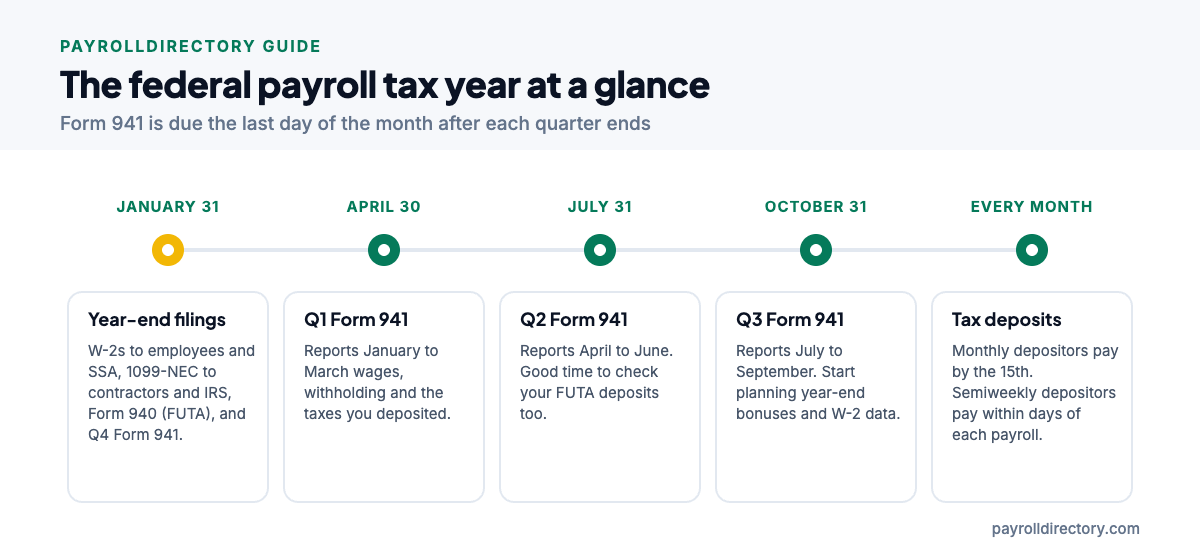
- Form 941 is due the last day of the month after each quarter: April 30, July 31, October 31 and January 31.
- January 31 is the big one: W-2s, 1099-NECs, Form 940 and the Q4 Form 941.
- Late deposits cost 2% to 15% of the amount, plus interest.
Here’s a fact that surprises a lot of new employers: paying your people is only half of payroll. The other half is a second calendar running quietly in the background, the one where you owe the IRS money and paperwork on specific dates.
Miss a payday and your team notices immediately. Miss a tax deposit and nobody notices for a while… until a notice arrives with a penalty attached. So let’s make that second calendar crystal clear.
Quick note before we start: this covers federal payroll taxes. Your state (and sometimes your city) has its own deadlines for income tax withholding and unemployment insurance, and they vary a lot. A local payroll provider will know them by heart.
First, what money are we even talking about?
When you run payroll, four federal taxes come into play:
- Federal income tax withholding. Taken out of each paycheck based on the employee’s W-4. It’s the employee’s money; you’re just holding it.
- Social Security tax. 6.2% from the employee and a matching 6.2% from you, on wages up to the yearly cap. For 2026 that cap (the wage base) is $184,500, so the most anyone pays is $11,439 on each side.
- Medicare tax. 1.45% from the employee and 1.45% from you, with no cap. Employees earning over $200,000 also have an extra 0.9% withheld; there’s no employer match on that part.
- Federal unemployment tax (FUTA). Employer-only. It’s 6.0% on the first $7,000 each employee earns in a year, but most employers get a credit of up to 5.4% for paying state unemployment tax, bringing it down to 0.6%. That works out to a maximum of $42 per employee per year.
One wrinkle on FUTA: if your state has borrowed from the federal unemployment fund and hasn’t paid it back, your credit shrinks. California is the current example. For 2026 it’s subject to a 1.5% credit reduction, which takes the effective rate there to 2.1%, or up to $147 per employee instead of $42. It’s not huge per person, but it surprises people every January.
Deposits: monthly or semiweekly?
This is where people get tripped up, so let’s slow down.
The income tax you withheld plus both halves of Social Security and Medicare have to be deposited electronically with the IRS. How often depends on which “depositor” you are, and the IRS decides that using something called the lookback period.
For Form 941 filers, the lookback period is the four quarters ending June 30 of the year before last. So your 2026 schedule is based on what you reported from July 1, 2024 to June 30, 2025.
- Reported $50,000 or less? You’re a monthly depositor. Taxes on wages you pay during a month are due by the 15th of the next month. Pay people in March, deposit by April 15. Brand-new employers are generally monthly depositors.
- Reported more than $50,000? You’re a semiweekly depositor. If payday is Wednesday, Thursday or Friday, the deposit is due the following Wednesday. If payday is Saturday through Tuesday, it’s due the following Friday.
- The $100,000 rule. If you ever pile up $100,000 or more in tax liability on a single day, it’s due the very next business day, no matter which schedule you’re on.
Here’s the part that trips people up most: your deposit schedule has nothing to do with how often you pay employees. You can pay weekly and still be a monthly depositor. It’s all about the dollar total in the lookback period.
Quarterly: Form 941
Every quarter you file Form 941, which reports the wages you paid, the taxes you withheld and the deposits you made. It’s generally due on the last day of the month after the quarter ends:
| Quarter | Months covered | Form 941 due |
|---|---|---|
| Q1 | January to March | April 30 |
| Q2 | April to June | July 31 |
| Q3 | July to September | October 31 |
| Q4 | October to December | January 31 |
If a due date lands on a weekend or holiday, it rolls to the next business day. Semiweekly depositors also attach Schedule B, which lists their tax liability day by day. And if you’re a very small employer, the IRS may tell you to file the annual Form 944 instead of quarterly 941s.
Year-end: January 31 is your busiest day
If you remember one date from this article, make it January 31. That’s when a whole pile of things are due at once:
- Form W-2 goes to every employee and to the Social Security Administration.
- Form 1099-NEC goes to contractors and the IRS. Big change here: for payments made in 2026 onward, you generally only need one when you’ve paid a contractor $2,000 or more in the year, up from the $600 threshold that had been around for decades. Payments made in 2025 still use $600.
- Form 940 reports your annual FUTA tax.
- Q4 Form 941 for October through December.
Pro tip: start year-end prep in early December. Confirm addresses, Social Security numbers and contractor details while people are still answering emails, not on January 29th.
What being late actually costs
The IRS failure-to-deposit penalty is based on how late you are. Here’s what it looks like on a single $10,000 deposit:
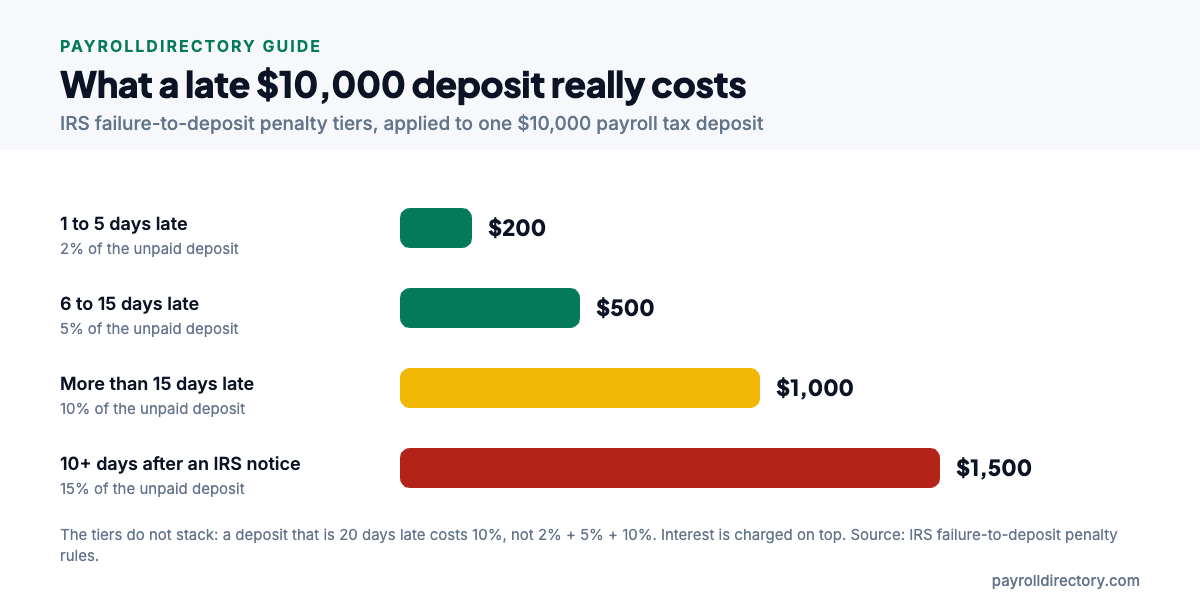
Interest gets added on top, and late returns have their own separate penalties.
And then there’s the one that keeps accountants up at night: the Trust Fund Recovery Penalty. The income tax and the employee’s share of Social Security and Medicare you withhold are considered held “in trust” for the government. If that money doesn’t get paid over, the IRS can hold owners and other responsible people personally liable for the full amount. Your LLC doesn’t protect you here. Never, ever use withheld payroll taxes to cover a cash crunch.
Don’t forget the hiring deadlines
Two more dates that are easy to miss when you’re excited about a new hire:
- Form I-9: the employee fills in Section 1 by their first day of work, and you complete Section 2 within three business days of their start date.
- New hire reporting: every state requires you to report new employees to a state registry, generally within 20 days of hire. Some states want it sooner.
The easiest way to never think about this again
Honestly? Hand it off. A full-service provider calculates every deposit, makes it on time and files every return, so these dates become their job instead of a reminder on your phone. Look for providers offering payroll tax filing, ask them the questions in my provider checklist, and read up on the most common payroll mistakes so you know what to watch for.
Frequently asked questions
How do I know if I’m a monthly or semiweekly depositor?
Add up the total tax liability you reported on Form 941 for the four quarters in your lookback period. $50,000 or less means monthly; more than $50,000 means semiweekly. The IRS also tells you in notices, and your payroll provider will track it.
Are state payroll tax deadlines the same as federal?
No. Every state sets its own withholding and unemployment deadlines, and some cities have local taxes too. That’s one of the best reasons to work with a provider who knows your state.
What if I realize I made a deposit mistake?
Fix it as fast as you can. Penalties grow with time, so a deposit that’s 3 days late costs far less than one that’s 3 weeks late. Your payroll provider or accountant can help you correct the return with Form 941-X if needed.
This guide is general information, not tax advice. Figures are for 2026. For the official rules, see IRS Publication 15 or talk to a tax professional.
Ready to find your payroll partner?
Compare 2,500+ independent payroll bureaus, CPA firms and PEOs across all 50 states and DC, then contact them directly. No middleman, no fees.