- Decide what kind of help you need first: payroll only, payroll plus accounting, or payroll plus HR and benefits.
- Ask every provider the same 12 questions so you can compare honestly.
- The cheapest quote is rarely the cheapest year. Ask for a full annual total.
- Service is the thing you will feel most. Find out exactly who picks up the phone.
Let me tell you how most small business owners choose a payroll provider.
They hire their first or fifth employee, panic a little about taxes, Google “payroll service,” sit through one demo, see a monthly price that seems fine, and sign. Then around month six they discover the year-end W-2 fee, the charge for running a bonus check, and the fact that “support” means a ticket that gets answered in two days.
I’m not saying that to scare you. I’m saying it because it’s completely avoidable. Choosing a payroll partner is one of the few business decisions where twenty minutes of the right questions saves you years of low-grade frustration. So let’s walk through it properly.
Step one: figure out what kind of help you actually need
Before you compare providers, compare types of providers. This is the step almost everyone skips, and it’s the one that matters most.
There are three main kinds of payroll partner, and they’re genuinely different businesses:
- Independent payroll bureaus live and breathe payroll. Many are local, family-run and have been doing this for decades. You usually get a named person who knows your account.
- CPA firms that run payroll fold payroll into bookkeeping, tax returns and advice. Great if you want one set of eyes on all your numbers.
- PEOs go much further. Through co-employment they take on payroll, benefits, workers’ comp and HR compliance.
A simple gut check: if your main worry is “I don’t want to mess up taxes,” start with a bureau. If it’s “I want someone who understands my whole financial picture,” look at a CPA firm. If it’s “I need health insurance and an HR department and I can’t afford to hire one,” look at a PEO. If you want the full breakdown, I wrote a side-by-side comparison of all three.
The 12 questions that predict whether you’ll be happy
Here’s the list I’d bring to every single call. Ask all of them, to every provider, and write the answers down. It sounds tedious. It’s the whole game.
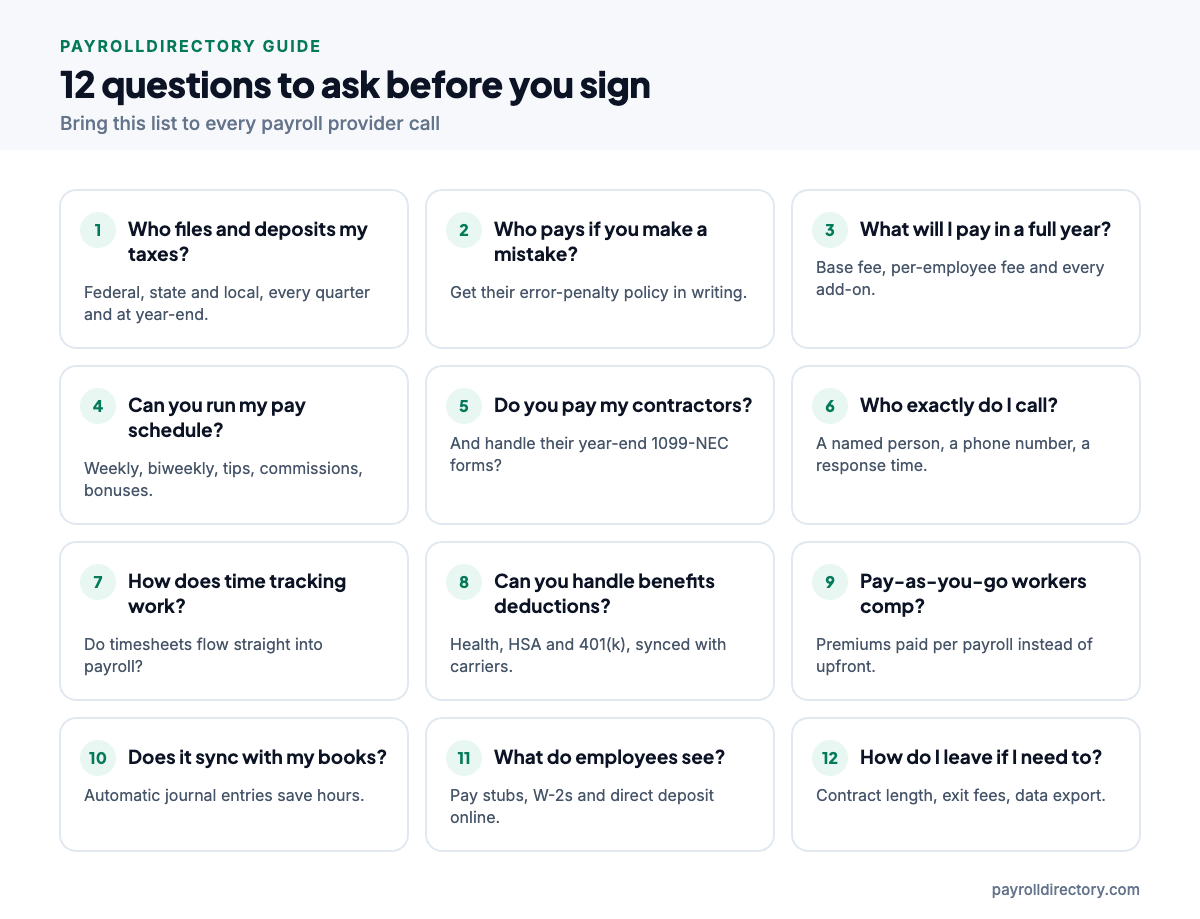
1. “Do you deposit and file all my payroll taxes?”
You want a yes that covers federal, state and local. That means making the tax deposits on time, filing quarterly Form 941 returns, the annual Form 940, and producing W-2s at year-end. If you have employees in more than one state, ask specifically about each state. Some providers are brilliant in their home state and shaky everywhere else.
2. “What happens if you make a mistake?”
This is my favourite question because the answer tells you so much. Good providers will say something like: “If a penalty is caused by our error, we pay it.” Get that in writing. And understand one uncomfortable truth: in the eyes of the IRS, the employer is still ultimately responsible for payroll taxes. A provider’s guarantee protects your wallet, but it doesn’t make the responsibility disappear, which is exactly why you want a provider that doesn’t make mistakes in the first place.
3. “What will I actually pay in a year?”
Not per month. Per year. Payroll pricing usually has a base fee plus a per-employee fee, and then a menu of extras: year-end forms, direct deposit, new state setups, off-cycle checks. Ask for a written annual total based on your real headcount and pay frequency. I break down the common fees in this guide to payroll pricing.
4. “Can you handle how I pay people?”
Weekly? Biweekly? Tipped staff? Commissions? Piece rate? A mix of hourly and salaried? Make sure they handle your exact situation without “workarounds,” because workarounds are where errors live.
5. “Do you pay my contractors too?”
If you use 1099 contractors, it’s handy when the same system pays them and prepares their year-end 1099-NEC forms. Heads up: for payments made in 2026 onward, the 1099-NEC reporting threshold went up from $600 to $2,000, so fewer small contractor payments need a form. A good provider tracks that for you.
6. “Who exactly do I call, and how fast do they answer?”
Payroll problems are urgent by nature. Someone’s paycheck is wrong on a Friday afternoon. You want a name, a direct number and a realistic response time. This is honestly where many local payroll bureaus beat big national platforms.
7. “How does time tracking work?”
If you have hourly staff, manual timesheet entry is where overtime errors sneak in. Ask whether time and attendance tools feed straight into payroll.
8. “Can you handle benefit deductions?”
Health premiums, HSAs, 401(k) contributions. Ask whether the provider connects directly to your carrier or plan administrator, or whether someone (you) has to key in changes by hand.
9. “Do you offer pay-as-you-go workers’ comp?”
Instead of paying a big estimated premium upfront, you pay with each payroll based on actual wages. For seasonal or growing businesses this can be a cash flow lifesaver. Here’s how pay-as-you-go workers’ comp works.
10. “Does it sync with my accounting software?”
A general ledger integration posts payroll journal entries automatically. Your bookkeeper will thank you.
11. “What do my employees get?”
Online pay stubs, W-2 access, direct deposit, maybe early wage access. A decent employee portal quietly removes a whole category of “hey, can you send me my pay stub?” messages from your life.
12. “How do I leave if this doesn’t work out?”
Ask about contract length, cancellation fees and whether you can export your full payroll history. A provider that’s confident in its service doesn’t need to lock you in.
Green flags and red flags
After a few calls you’ll start noticing patterns. Here’s what to watch for:
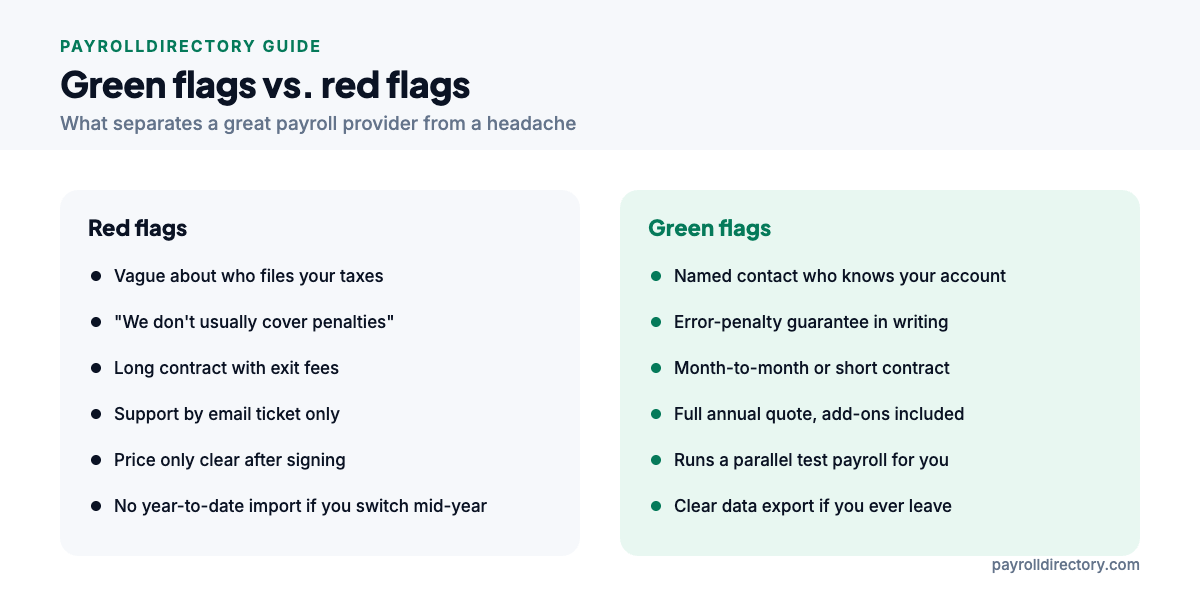
One more green flag that doesn’t fit neatly on a chart: when a provider asks you a lot of questions. How many states, how you pay, whether you have tipped employees, what your current provider files. That’s someone who’s thinking about getting it right, not just closing the sale.
A quick word on price
I get it, price matters. But here’s how I’d think about it. Say two providers quote you $40 a month apart. Over a year that’s $480. One late payroll tax deposit of $10,000 that sits for more than 15 days costs you a $1,000 penalty on its own. One misconfigured withholding setting can mean a messy correction across every employee. The difference between a good provider and an average one is rarely the monthly fee. It’s everything that doesn’t go wrong.
How to actually run the comparison
- Shortlist three providers. Start local. Providers in your state know your state’s withholding and unemployment rules. You can browse providers by state right here.
- Send everyone the same facts. Number of employees and contractors, pay frequency, states, and the services you want.
- Ask the 12 questions. Same order, same wording.
- Get written annual quotes. Including year-end and add-ons.
- Pick the one you’d want to call on a bad day. Seriously. That’s the tiebreaker.
Frequently asked questions
When should a small business start using a payroll provider?
Usually with the first employee. The tax deposit schedule, quarterly filings and year-end forms start immediately, and mistakes are easiest to avoid when you set things up correctly from day one.
Is payroll software the same as a payroll provider?
Not quite. Software gives you the tools and you do the work. A full-service provider does the work for you, including filing and depositing taxes. Many providers use software under the hood but add a human who checks things.
Can I switch payroll providers mid-year?
Yes. It takes a bit more care because year-to-date totals have to move over, but it’s routine. Here’s my step-by-step guide to switching.
Ready to find your payroll partner?
Compare 2,500+ independent payroll bureaus, CPA firms and PEOs across all 50 states and DC, then contact them directly. No middleman, no fees.