- The two most expensive mistakes: misclassifying employees as contractors and missing tax deposits.
- The most dangerous: using withheld taxes to cover cash flow, which can make you personally liable.
- Most of these are cheap to prevent with a calendar, a checklist or a good provider.
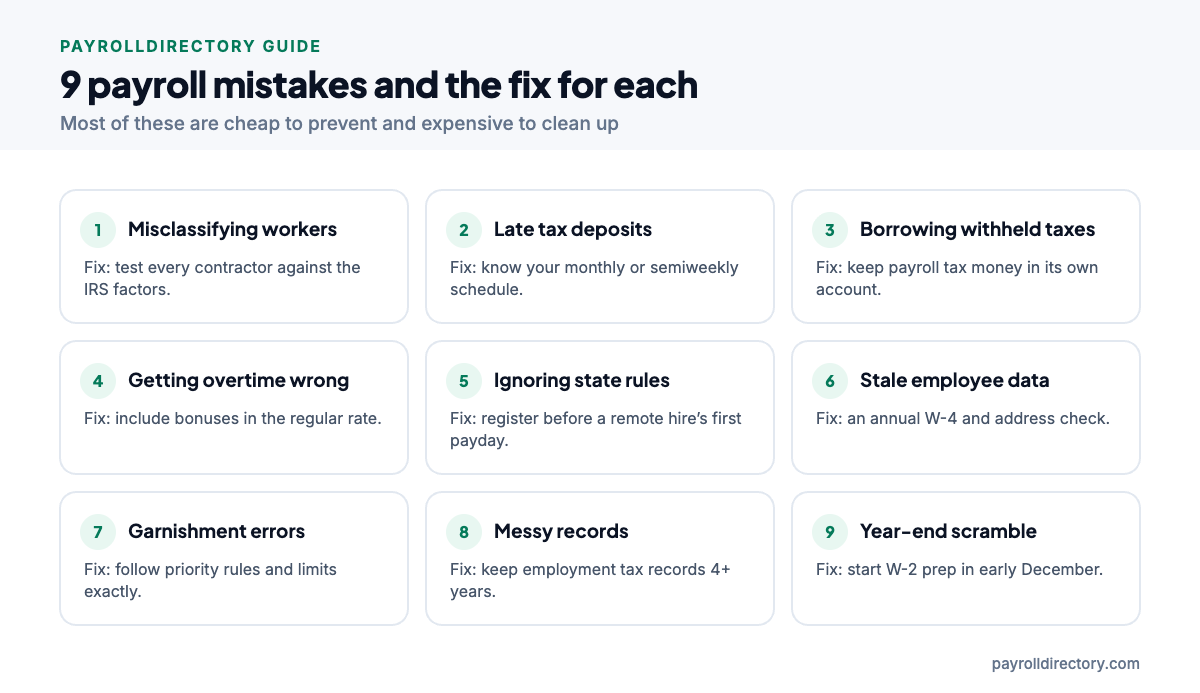
Payroll mistakes are sneaky. They almost never blow up on the day you make them. A wrong setting in January quietly repeats every pay period. A contractor who should have been an employee goes unnoticed for two years. Then one day a letter arrives, and suddenly a small slip has compounded into a big, expensive problem.
The good news? The same handful of mistakes come up again and again, and nearly all of them are easy to prevent once you know what to look for. Here are the nine I’d want every small business owner to know about.
1. Misclassifying employees as contractors
Paying someone on a 1099 is simpler. No withholding, no payroll taxes, no benefits. That’s exactly why it’s tempting, and exactly why the IRS and state agencies look closely at it.
If a worker should legally be an employee, misclassifying them can mean back payroll taxes, penalties and interest, plus possible state unemployment and wage claims. The IRS looks at three broad areas:
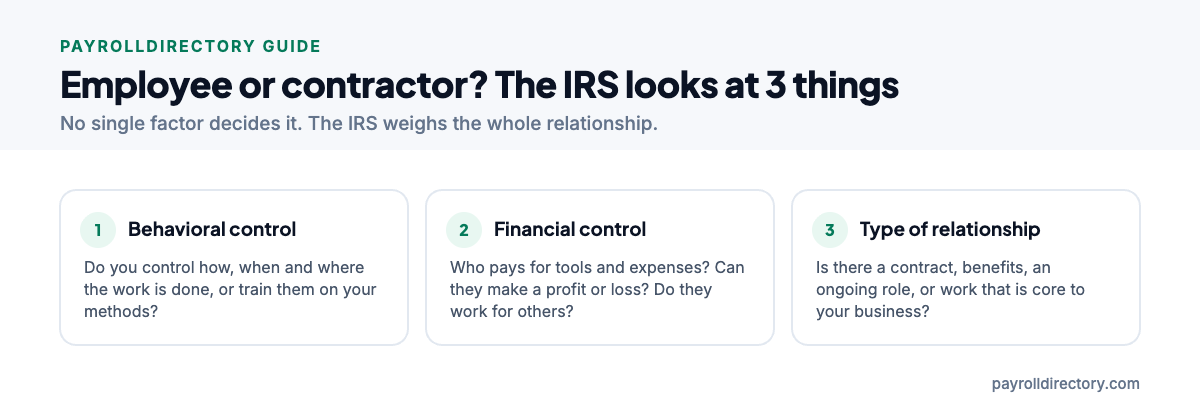
Rule of thumb: if you set their hours, provide their tools, train them on your methods and they only work for you, they probably look like an employee. Some states use stricter tests than the IRS. When in doubt, ask your accountant before the first payment, not after the audit.
2. Missing payroll tax deposit deadlines
Federal payroll taxes are due on a monthly or semiweekly schedule, and penalties start the day after the deadline: 2% if you’re 1 to 5 days late, 5% for 6 to 15 days, 10% after that, and 15% if it’s still unpaid 10 days after an IRS notice. On a $10,000 deposit, that’s $200 to $1,500 for something completely avoidable.
Fix: know which schedule you’re on and put every deposit date in the calendar, or let a provider handle it. My payroll tax deadline guide explains the whole calendar.
3. “Borrowing” withheld taxes during a tight month
This is the one I’d underline twice. The income tax and the employee share of Social Security and Medicare you withhold aren’t your money. You’re holding them in trust for the government.
If they don’t get paid over, the IRS can use the Trust Fund Recovery Penalty to make owners and other responsible people personally liable for the full amount. Your business structure doesn’t shield you from it.
Fix: treat payroll tax money as untouchable. Some owners move it into a separate bank account on payday so it never mingles with operating cash.
4. Getting overtime wrong
Under federal law, non-exempt employees generally get time and a half for hours over 40 in a workweek. Two common slips:
- Forgetting bonuses and commissions. The “regular rate” used for overtime often includes non-discretionary bonuses and commissions, not just the hourly wage.
- Forgetting state rules. Some states have daily overtime or other rules on top of federal law. California is the famous example.
Fix: use time tracking that feeds payroll and confirm your overtime setup with your provider.
5. Ignoring state and local rules
Minimum wage, paid sick leave, final paycheck timing and local income taxes all vary by state, and sometimes by city. The classic trap today is the remote hire: one employee in a new state can mean new withholding and unemployment registrations before their first payday.
Fix: before you hire in a new state, ask your provider what registrations are needed. A local provider who knows that state is a big advantage.
6. Stale employee information
Old addresses mean W-2s that bounce. Outdated W-4s mean the wrong withholding all year. A mistyped Social Security number creates a mismatch with the SSA.
Fix: once a year, ask everyone to review their details in the employee portal. It takes five minutes.
7. Mishandling wage garnishments
Child support orders, IRS levies, student loan garnishments and creditor garnishments all have different priority rules and limits on how much you can take. Get it wrong and the employer can end up liable for the amount that should have been withheld.
Fix: follow each order exactly, or use a provider that offers garnishment administration.
8. Messy record keeping
The IRS generally expects employers to keep employment tax records for at least four years, and wage and hour laws have their own record requirements. If you ever face an audit or a wage claim, your records are your defense.
Fix: keep timesheets, pay records and filings organized digitally. Most payroll providers store this for you automatically.
9. The year-end scramble
W-2s, 1099-NECs and Form 940 are all generally due by January 31, right after the holidays. Missing addresses and contractor details turn that into a stressful week.
Fix: start year-end prep in early December. And note the new rule: for payments made in 2026 onward, you generally only issue a 1099-NEC to contractors you paid $2,000 or more.
The pattern behind all nine
Look back at the list and you’ll notice something. Almost none of these are about not being smart enough. They’re about payroll being a constant, detail-heavy, deadline-driven job that competes with everything else you’re doing. That’s exactly why so many owners hand it off.
If you’re doing payroll yourself, or your current provider is letting things slip, my guides on choosing a payroll provider and switching providers will get you sorted.
Frequently asked questions
What’s the most common payroll mistake?
Worker misclassification and late tax deposits are among the most common and most costly. Both are very preventable.
Can a payroll provider fix mistakes from previous years?
Many can help prepare corrected returns (like Form 941-X or W-2c). Some charge extra for amendments, so ask.
Who’s responsible if my payroll provider makes a mistake?
The IRS generally holds the employer responsible for payroll taxes. That’s why you want a provider with a written policy to cover penalties caused by its own errors, and good habits like reviewing each payroll summary.
This article is general information, not legal or tax advice.
Ready to find your payroll partner?
Compare 2,500+ independent payroll bureaus, CPA firms and PEOs across all 50 states and DC, then contact them directly. No middleman, no fees.