- A PEO co-employs your team: you run the business, the PEO handles payroll, taxes, benefits and HR administration.
- The big win is benefits. Pooling many small companies lets you offer plans that usually only larger employers get.
- The trade-offs are cost, less flexibility and a harder exit.
- PEOs tend to make the most sense somewhere around 10 to 100 employees, when you’re hiring and have no HR person.
If you’ve ever been told “you should look at a PEO” and nodded politely while having no idea what that meant, you’re in very good company.
PEO stands for professional employer organization. And it’s one of the most useful (and most misunderstood) tools available to small businesses. So let’s demystify it properly: what it is, how it actually works day to day, what it costs, and how to tell whether it’s right for you.
The one-sentence version
A PEO becomes a co-employer of your staff, taking on the administrative side of being an employer (payroll, taxes, benefits, HR compliance) while you keep running the business and managing your people.
That’s it. The magic, and the complexity, is all in the word “co-employer.”
How co-employment actually works
When you join a PEO, you sign a client service agreement that splits employer responsibilities between you and the PEO. Here’s roughly how that split looks:
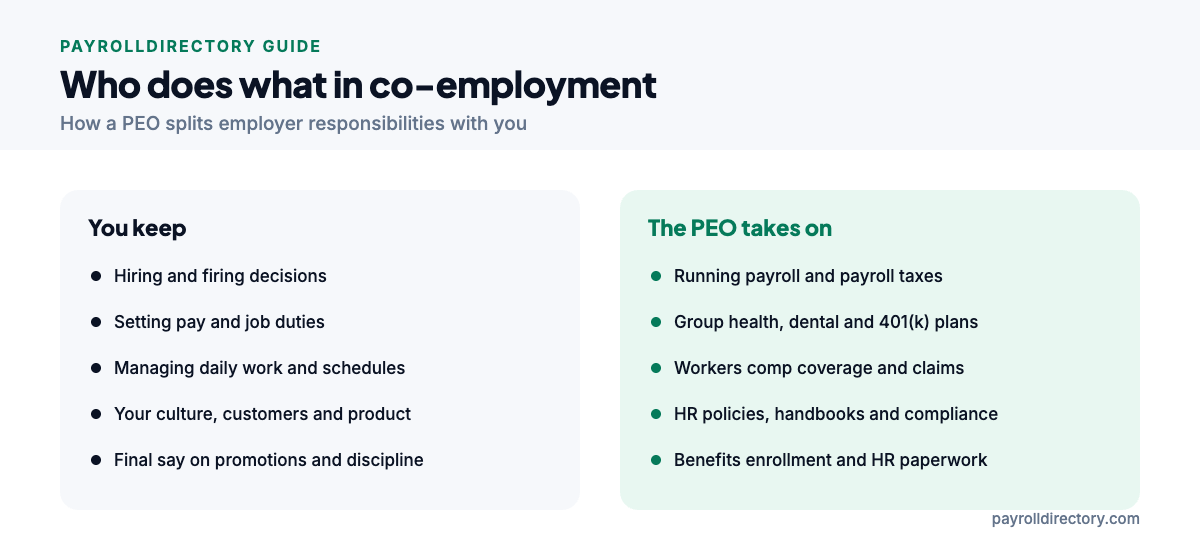
So what changes for your employees? Honestly, not much day to day. They still work for you, report to you and get hired, promoted and managed by you. They’ll just see the PEO’s name on some things, like their pay stub, benefits enrollment and possibly their W-2.
One important detail: PEOs often report and pay payroll taxes under their own employer identification number, not yours. The IRS runs a certification program for this, and an IRS Certified PEO (CPEO) takes on federal employment tax liability for the wages it pays to your worksite employees. That’s a meaningful layer of protection, which is why “Are you an IRS-certified CPEO?” is one of the first questions I’d ask.
Why so many small businesses use them
PEOs are much more common than most owners realize:
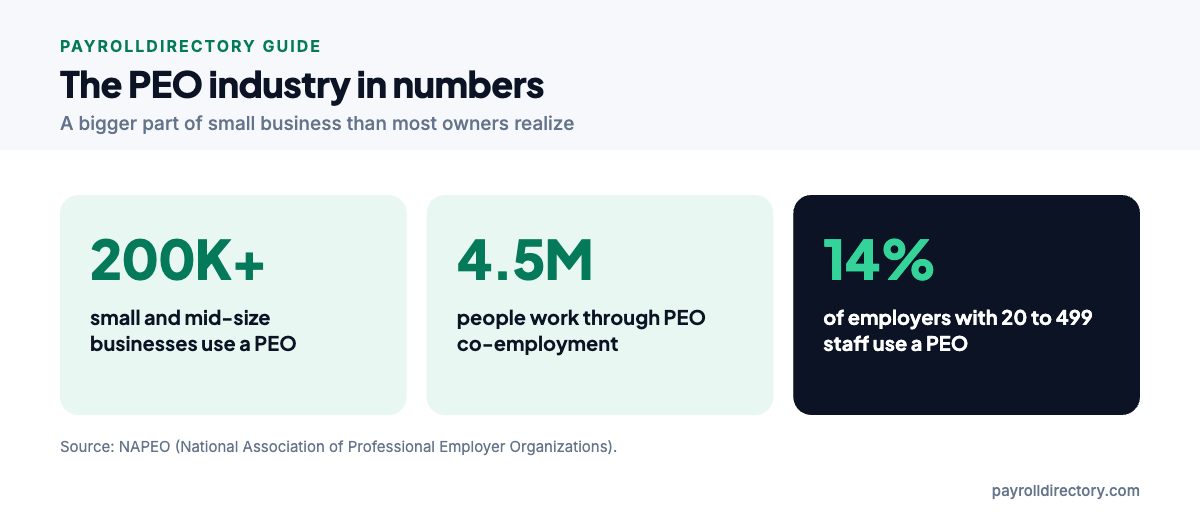
Here’s why they’re popular:
1. Benefits that punch above your weight
This is the big one. Insurance carriers price group health plans partly on the size of the group. A 12-person company on its own has very little leverage. A PEO pools employees from hundreds or thousands of client companies, so your 12 people get access to plans that look like a much larger employer’s. When you’re competing for talent with bigger companies, that matters a lot.
2. An HR department you didn’t have to hire
Writing an employee handbook. Handling a tricky termination. Figuring out leave rules in a new state. Most small businesses don’t have an HR person, so these things land on the owner. A PEO gives you HR professionals to call.
3. One provider instead of five
Payroll company, benefits broker, workers’ comp insurer, HR consultant, retirement plan administrator. A PEO can replace that whole stack with one relationship and one invoice.
The trade-offs nobody puts in the brochure
Cost
A PEO does a lot more than payroll, so it costs more than payroll. Most charge either a percentage of your total payroll or a flat fee per employee per month, and benefit premiums and workers’ comp are often billed on top. The fair comparison isn’t “PEO vs. my payroll fee.” It’s “PEO vs. everything it replaces.”
Less flexibility
You choose from the PEO’s benefit menu, follow its processes and use its technology. If you love a specific health plan or have unusual HR practices, that can chafe.
Leaving is real work
Exiting a PEO means rebuilding benefits, workers’ comp coverage and possibly state tax accounts on your own. It’s doable, but plan for it before you join, not after.
Six signs you might be ready for a PEO
- You’re actively hiring and candidates keep asking about benefits.
- You have no HR person, or the person doing HR is also doing three other jobs.
- You’re expanding into new states and drowning in registration and compliance rules.
- Your workers’ comp costs or claims are a headache.
- You’d happily trade some control for getting your evenings back.
- You’re somewhere around 10 to 100 employees. Smaller teams may not need it; much larger teams often bring HR in-house.
And signs it’s probably not the right fit yet: you only need accurate payroll and tax filing, you’re happy with your current benefits, or you’re very small and price sensitive. In that case an independent payroll bureau is usually simpler and cheaper. My bureau vs. CPA vs. PEO comparison walks through that decision.
Questions to ask any PEO before you sign
- Are you an IRS-certified CPEO?
- Which benefit plans are available in my state, and what will they cost my employees, not just the company?
- What exactly is included in the fee, and what’s billed separately?
- How do you handle workers’ comp claims and unemployment claims?
- Who is my day-to-day contact, and how quickly do they respond?
- What’s the notice period and process if we leave, and how do benefits transition?
A fair way to compare a PEO quote
The most common mistake when evaluating a PEO is comparing its fee to your current payroll fee. Of course the PEO looks expensive that way. It’s doing far more.
Instead, list what you pay today for everything a PEO would replace:
- Your payroll service
- Your health, dental and vision premiums, plus any broker fees
- Your workers’ comp premium
- Your 401(k) plan administration fees
- HR help: consultants, legal calls about employee issues, HR software
- And honestly, the hours you personally spend on all of the above
Then put the PEO’s full quote next to that total. Sometimes the PEO wins clearly, especially on benefits. Sometimes a payroll bureau plus a good benefits broker is better value. Either way, you’re making the decision on real numbers.
Frequently asked questions
Do I lose control of my employees with a PEO?
No. You still hire, fire, set pay, assign work and manage performance. The PEO handles the administrative and compliance side of being an employer.
Will my employees know we use a PEO?
Yes, usually. The PEO’s name may appear on pay stubs, benefits materials and W-2s. Most PEOs help you explain the change to your team when you onboard.
Is a PEO worth it for a 5-person company?
Sometimes, especially if benefits are your main hiring challenge. But at that size many businesses are well served by a payroll bureau plus a benefits broker. Get quotes for both and compare the full picture.
Browse PEOs and HR outsourcing providers in the directory
Ready to find your payroll partner?
Compare 2,500+ independent payroll bureaus, CPA firms and PEOs across all 50 states and DC, then contact them directly. No middleman, no fees.