- Most payroll services charge a base fee plus a per-employee fee. PEOs usually charge a percentage of payroll or a per-employee monthly fee.
- The monthly price is only part of the story. Year-end forms, extra states and add-ons can change the total a lot.
- Always compare annual totals built from the same facts.
- The cheapest quote and the cheapest year are often two different providers.
“So what does it cost?” is usually the first question people ask about payroll services. And it’s a fair question! The frustrating part is that the honest answer is “it depends,” and most pricing pages don’t explain on what.
So instead of throwing a random number at you, let me show you how payroll pricing actually works. Once you understand the structure, comparing quotes gets a lot easier, and you’ll spot the fees that make a “cheap” provider expensive.
The three main pricing models
1. Base fee + per-employee fee (the most common)
This is how most payroll bureaus and online payroll services price. You pay a fixed base fee (per payroll run or per month) plus a per-employee or per-check charge.
Two things push this up quickly: headcount, obviously, and pay frequency. Weekly payroll means 52 runs a year. Biweekly is 26. Semimonthly is 24. If you’re charged per run, switching from weekly to biweekly can cut that part of your bill in half.
2. Flat monthly or bundled pricing
Many CPA firms quote one monthly number that covers payroll, payroll tax filing and sometimes bookkeeping. It’s easy to budget, which is lovely. Just make sure you know exactly what’s inside the bundle and what happens to the price as you hire.
3. Percentage of payroll or per employee per month (PEOs)
PEOs typically charge either a percentage of your total gross payroll or a flat amount per employee per month, because they’re bundling payroll with HR, benefits administration and often workers’ comp. Benefit premiums are usually on top. A PEO quote will always look bigger than a payroll-only quote, so compare it against everything it replaces. More on that in my PEO explainer.
Let’s do the math on an example
Here’s a made-up quote for a 10-person team paid every two weeks. The numbers are illustrative, not any real provider’s pricing, but the structure is very typical:
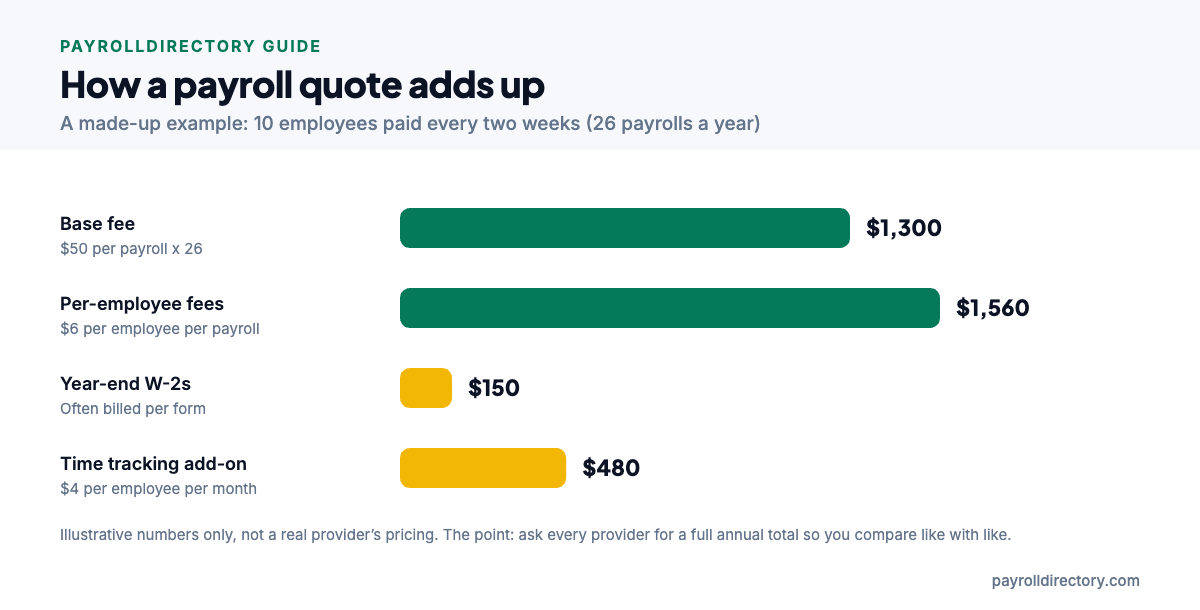
Notice how the base fee and per-employee fee are only part of the picture. The year-end forms and the time tracking module add over $600 to the annual total. Now imagine provider B quotes a lower monthly price but charges more per W-2 and for every off-cycle bonus run. Comparing monthly prices would have led you to the wrong answer.
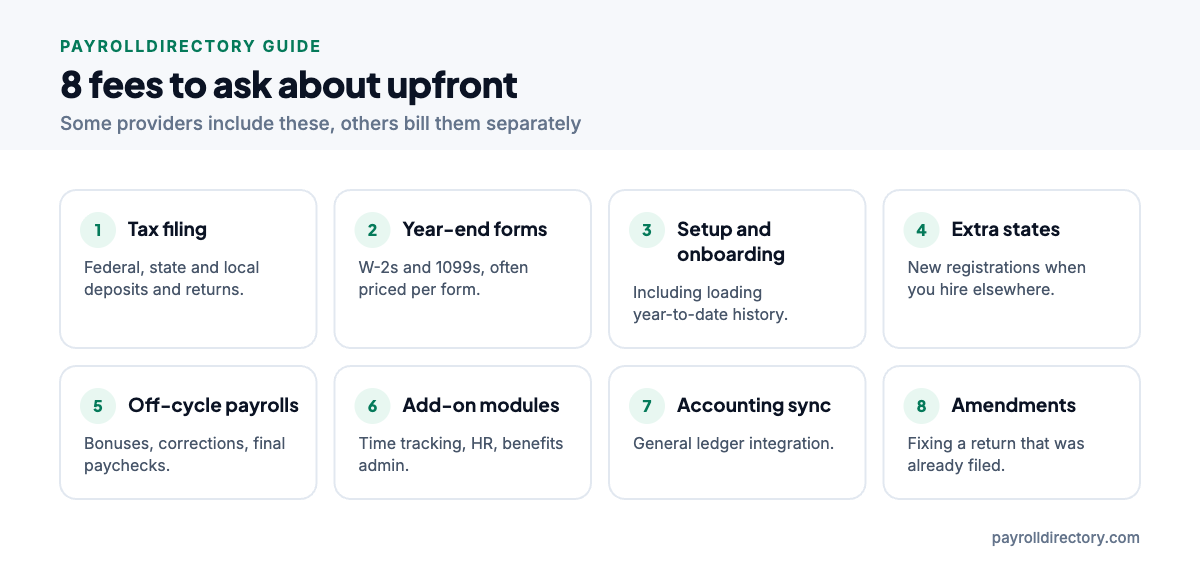
The fees that sneak in
Some providers include all of these. Others bill each one separately. Ask about every single one:
What makes your price go up (or down)
- Headcount. More people, more per-employee charges.
- Pay frequency. Weekly costs more than biweekly or semimonthly if you’re charged per run.
- Number of states. Every state adds withholding and unemployment accounts, filings and sometimes local taxes.
- Complexity. Tips, commissions, multiple pay rates, garnishments and certified payroll for government contracts all take extra work.
- Service level. A dedicated specialist who knows your account costs more than self-service software. It can also save you from very expensive mistakes.
“Can’t I just do it myself for free?”
You can! Plenty of owners run their own payroll, especially with one or two employees. But “free” isn’t quite the right word. Count:
- Your time. Calculating, depositing, filing, fixing. Every pay period and every quarter.
- Software. You’ll still need a payroll tool to calculate withholding correctly.
- Risk. A deposit that’s more than 15 days late costs 10% of the amount. On a $10,000 deposit, that’s $1,000, which is probably more than a year of the difference between two payroll providers. My payroll tax deadline guide shows the full penalty ladder.
For a lot of small businesses, the provider’s fee is basically insurance against the mistakes that cost far more.
How to compare quotes like a pro
- Write down your facts once. Number of employees and contractors, pay frequency, states, and the services you want.
- Send the same facts to three providers. Starting local is smart. Here’s the full list of providers by state.
- Ask for an annual total in writing, including year-end forms and every add-on you plan to use.
- Ask about contracts and price increases. Is it month to month? How much did prices go up last year?
- Ask who pays penalties caused by their errors.
- Weigh service. Who answers when something goes wrong, and how fast?
And use my 12-question checklist alongside the quotes, because price is only one of the things that’ll determine whether you’re happy in a year.
What you’re really paying for: the three service levels
It helps to think of payroll services in three tiers, because a lot of the price difference comes down to which tier you’re buying.
Self-service software. You enter hours, the software calculates pay and taxes, and depending on the product it may or may not file and deposit taxes for you. Cheapest, but you are the safety net. If something looks off, you’re the one who has to notice.
Full-service payroll. The provider runs payroll, deposits and files all your payroll taxes, and produces year-end forms. Most payroll bureaus live here. You still review and approve each payroll, but the compliance work is theirs.
Managed or bundled service. A named specialist handles your account, answers questions, handles new-state registrations and often adds HR support or benefits administration. CPA firms and PEOs often sit here. Highest price, least of your time.
When two quotes look wildly different, check whether you’re comparing the same tier. A self-service quote and a full-service quote aren’t really competing products.
Frequently asked questions
Is it cheaper to use a local payroll company or a national one?
It varies. National platforms can be inexpensive for very simple payrolls. Local bureaus are often competitive once you factor in service, multi-state help and fewer surprise fees. Get both kinds of quotes and compare annual totals.
Do payroll providers charge setup fees?
Some do, some waive them, and some charge only when you switch mid-year and they have to load year-to-date history. Ask upfront.
Can I negotiate payroll pricing?
Often, yes, especially on setup fees, year-end fees or bundles. Having two competing written quotes helps.
Ready to find your payroll partner?
Compare 2,500+ independent payroll bureaus, CPA firms and PEOs across all 50 states and DC, then contact them directly. No middleman, no fees.